 Love music trivia? 🎵 Try Weekly Spin, our daily social music discovery diary!
Music History: Understanding Album Release Years
Album release years aren't just dates—they're windows into musical history, cultural movements, and the evolution of sound. Every decade in modern music has left behind a distinctive fingerprint: a combination of production styles, lyrical themes, visual aesthetics, and cultural forces that make albums from that era unmistakable. Whether you're a casual listener or a dedicated music historian, understanding these patterns will transform the way you experience music. In trivia games like Album Year Guess on guess-games.com, this knowledge becomes your secret weapon, helping you place albums within a year or two of their actual release. In this guide, we'll walk through the major eras of popular music, highlight landmark albums that defined each decade, explore how production techniques and cultural context serve as reliable timeline markers, and share practical strategies for sharpening your guessing skills.
The Evolution of Music Eras
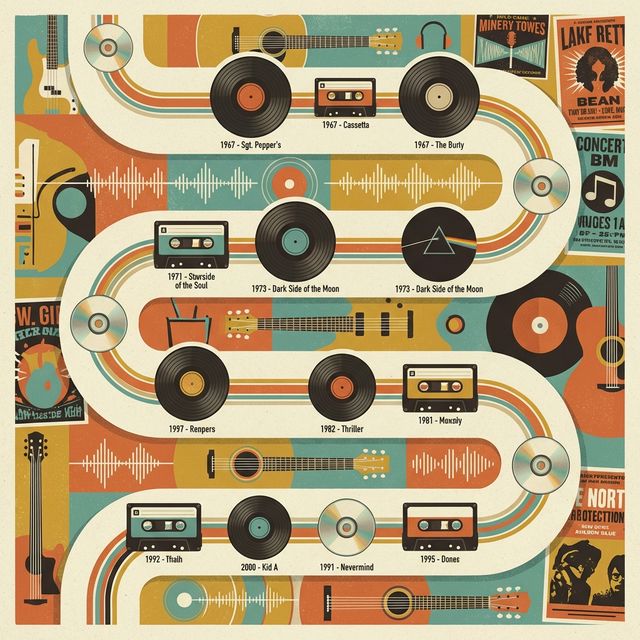
Music history can be mapped across distinct eras, each with a sonic identity shaped by the technology, culture, and artists of the time. The late 1950s and early 1960s laid the groundwork with rock and roll pioneers like Chuck Berry and Little Richard, whose raw energy and simple arrangements set the stage for everything that followed. By the mid-1960s, the British Invasion—led by The Beatles, The Rolling Stones, and The Who—reshaped popular music worldwide. The Beatles' "Sgt. Pepper's Lonely Hearts Club Band" (1967) pushed the boundaries of what a studio album could be, introducing orchestral arrangements, tape loops, and concept-album storytelling to mainstream rock. The late 1960s also gave rise to psychedelic rock and the counterculture movement, with albums that experimented freely with studio effects and unconventional song structures. The 1970s diversified the landscape dramatically. Led Zeppelin's "IV" (1971) defined hard rock with its thunderous riffs and mystical lyrics, while Pink Floyd's "The Dark Side of the Moon" (1973) became a landmark of progressive rock, blending philosophical themes with innovative production. Fleetwood Mac's "Rumours" (1977) captured the soft-rock California sound and became one of the best-selling albums of all time. Meanwhile, punk rock emerged in the mid-1970s as a raw, anti-establishment reaction to the perceived excess of progressive rock. The 1980s introduced synthesizers, drum machines, and digital recording, creating a polished, larger-than-life sound. Michael Jackson's "Thriller" (1982) became the best-selling album in history, blending pop, funk, and rock with groundbreaking music videos. Guns N' Roses' "Appetite for Destruction" (1987) delivered a hard-edged alternative to the era's glossy pop. The 1990s swung the pendulum back toward rawness: Nirvana's "Nevermind" (1991) dethroned polished pop from the charts and ushered in the grunge era, while Radiohead's "OK Computer" (1997) anticipated the anxieties of the internet age with its layered, experimental arrangements. The 2000s and beyond have been defined by digital production, genre-blending, and global connectivity, with artists like Daft Punk, Amy Winehouse, Kendrick Lamar, and Tyler, The Creator each pushing music in bold new directions.
Key Albums That Defined Decades
Certain albums serve as cultural monuments—anchor points around which entire decades revolve. Memorizing these landmark releases and their years is one of the most effective strategies for music trivia. In the 1960s, The Beatles' "Sgt. Pepper's Lonely Hearts Club Band" (1967) stands as the definitive psychedelic-era statement, combining Indian instrumentation, studio experimentation, and vivid storytelling. Its influence was so profound that it reshaped expectations for what a rock album could achieve. Moving into the 1970s, Led Zeppelin's "IV" (1971) anchored the hard-rock genre with timeless tracks, while Pink Floyd's "The Dark Side of the Moon" (1973) spent over 900 weeks on the Billboard 200, becoming synonymous with progressive rock's ambition. Fleetwood Mac's "Rumours" (1977) captured the emotional turmoil of its band members while delivering impeccably crafted soft rock, selling over 40 million copies worldwide. The 1980s are impossible to discuss without Michael Jackson's "Thriller" (1982), an album that transcended genre boundaries and revolutionized the music video as an art form. Later in the decade, Guns N' Roses released "Appetite for Destruction" (1987), injecting gritty, street-level authenticity into a scene dominated by hair metal. The 1990s saw seismic shifts: Nirvana's "Nevermind" (1991) toppled Michael Jackson from the number-one chart position and signaled the arrival of grunge as a dominant force. Radiohead's "OK Computer" (1997) closed the decade with a haunting vision of technology's grip on humanity, influencing a generation of alternative and experimental artists. In the 2000s, Daft Punk's "Discovery" (2001) fused house music with pop melodies and retro-futuristic aesthetics, helping bring electronic music to mainstream audiences. Amy Winehouse's "Back to Black" (2006) revived vintage soul and jazz influences with a raw, confessional edge that earned critical acclaim and multiple Grammy Awards. The 2010s brought Kendrick Lamar's "To Pimp a Butterfly" (2015), a sprawling fusion of hip-hop, jazz, funk, and spoken word that addressed racial identity and systemic injustice, widely regarded as one of the greatest albums of its decade. Tyler, The Creator's "IGOR" (2019) defied genre classification entirely, blending neo-soul, synth-pop, and rap into a bold artistic statement that won the Grammy for Best Rap Album. Each of these albums doesn't exist in isolation—they connect to the sounds, movements, and innovations surrounding them, creating a web of reference points you can use to date unfamiliar records.
Genre Evolution and Timeline Clues
Different genres follow recognizable evolutionary arcs that serve as reliable timeline clues. Rock and roll began in the 1950s with a simple formula—guitar, bass, drums, and vocals. By the mid-1960s it had splintered into folk rock, psychedelic rock, and garage rock. The 1970s pushed rock into progressive territory with extended compositions and concept albums, before punk rock stripped everything back to three chords and raw energy in 1976-1977. The 1980s saw rock fragment further into new wave, post-punk, glam metal, and thrash metal, each with distinct sonic signatures. Grunge dominated the early 1990s, giving way to Britpop and alternative rock by mid-decade. Post-rock and indie rock emerged in the late 1990s and 2000s, emphasizing atmosphere and texture over traditional song structures. Hip-hop tells an equally rich story. Born in the late 1970s in New York City, it evolved from party music with simple breakbeats into a complex art form. The mid-1980s brought socially conscious rap and early sampling techniques. The 1990s divided hip-hop between East Coast lyricism and West Coast G-funk production, while the late 1990s and 2000s saw Southern rap, crunk, and snap music reshape the mainstream. By the 2010s, hip-hop had become the dominant genre in popular music, with artists like Kendrick Lamar blending jazz, funk, and spoken word into their work on "To Pimp a Butterfly" (2015). Electronic music has its own clear timeline: early synth-pop in the late 1970s and 1980s with Kraftwerk and Depeche Mode, the acid house and rave explosion of the late 1980s and early 1990s, the rise of trance and drum and bass in the mid-1990s, and the mainstream EDM boom of the 2010s. Daft Punk's "Discovery" (2001) sits at a pivotal crossroads, bridging underground French house with pop accessibility. Soul and R&B evolved from Motown's polished 1960s sound through the funk-infused 1970s, the synth-heavy quiet storm of the 1980s, new jack swing in the early 1990s, and neo-soul in the late 1990s and 2000s. Amy Winehouse's "Back to Black" (2006) drew directly from 1960s girl-group aesthetics while sounding unmistakably modern. Recognizing where an album falls within its genre's arc is one of the most powerful tools for narrowing down release years.
Production Techniques as Time Markers
Production techniques are perhaps the most reliable audible clues for dating an album, because they are directly tied to the recording technology available at the time. In the early 1960s, Phil Spector pioneered the "Wall of Sound" technique—layering multiple instruments playing the same parts to create a dense, reverb-drenched sonic tapestry. This approach defined the era's pop and girl-group recordings, and its influence echoed through albums like The Beatles' "Sgt. Pepper's Lonely Hearts Club Band" (1967), which pushed multitrack recording to its limits on four-track tape machines. The 1970s brought multitrack recording to wider use, allowing for more separation and clarity between instruments. Albums like Pink Floyd's "The Dark Side of the Moon" (1973) showcased analog warmth combined with innovative use of synthesizers, tape loops, and sound effects. The rich, warm character of analog tape recording gives 1970s albums a distinctive sonic quality that digital recordings rarely replicate. Fleetwood Mac's "Rumours" (1977) exemplified the polished yet organic California studio sound, with pristine vocal harmonies and layered guitar textures. The 1980s represent a dramatic production shift. Digital reverb units, synthesizers like the Yamaha DX7, and drum machines became ubiquitous. One of the most recognizable production signatures of the decade is the gated reverb drum sound, popularized by Phil Collins on his solo work and with Genesis. This technique—where a noise gate abruptly cuts off the reverb tail of a snare drum—created a massive, punchy sound that defined countless 1980s recordings. You can hear it prominently on Michael Jackson's "Thriller" (1982) and throughout Guns N' Roses' "Appetite for Destruction" (1987), albeit tempered with a rawer rock edge. The 1990s saw a deliberate move away from the 1980s' digital sheen. Grunge bands like Nirvana embraced lo-fi recording techniques, distorted guitars, and minimal studio trickery. "Nevermind" (1991) was produced by Butch Vig with a sound that balanced punk rawness with enough polish for radio play—a formula that became the template for alternative rock production. Radiohead's "OK Computer" (1997) introduced atmospheric layering and electronic textures that anticipated the experimental production of the 2000s. A pivotal moment in production history came with Cher's "Believe" (1998), which popularized the use of Auto-Tune as a deliberate vocal effect rather than a correction tool. This marked the beginning of the Auto-Tune era, which would dominate pop and hip-hop production throughout the 2000s and 2010s. Modern production often blends vintage and contemporary techniques—Tyler, The Creator's "IGOR" (2019) combines analog synthesizers with digital processing, creating a sound that is both retro and futuristic. Training your ear to recognize these production markers will give you a significant advantage in guessing album years.
Cultural Context and Album Themes
Albums don't exist in a vacuum—they are products of their time, shaped by the political events, social movements, and cultural anxieties of the era in which they were created. Understanding this context provides powerful clues for dating music. The 1960s were defined by the civil rights movement, the Vietnam War, and the counterculture revolution. Albums like "Sgt. Pepper's Lonely Hearts Club Band" (1967) reflected the era's spirit of experimentation and optimism, while later 1960s recordings grew darker as political assassinations and the escalation of war took their toll. The 1970s grappled with the aftermath: economic recession, the oil crisis, Watergate, and disillusionment. Pink Floyd's "The Dark Side of the Moon" (1973) explored themes of madness, greed, and mortality that resonated with a generation questioning societal structures. Led Zeppelin's "IV" (1971) drew on mysticism and fantasy as an escape from the era's uncertainties, while Fleetwood Mac's "Rumours" (1977) channeled deeply personal relationship turmoil into universally relatable pop-rock. The 1980s celebrated excess, materialism, and technological optimism. Michael Jackson's "Thriller" (1982) embodied the decade's ambition and spectacle, while Guns N' Roses' "Appetite for Destruction" (1987) offered a grittier perspective from the streets of Los Angeles, reflecting the darker undercurrents beneath the decade's glossy surface. The 1990s brought a wave of introspection and anti-consumerism. Nirvana's "Nevermind" (1991) channeled Generation X's alienation and frustration, while Radiohead's "OK Computer" (1997) anticipated anxieties about technology, surveillance, and dehumanization that would become central concerns in the internet age. The 2000s were shaped by 9/11, the Iraq War, and the rise of social media. The 2010s saw music increasingly address racial justice, identity politics, mental health, and climate anxiety. Kendrick Lamar's "To Pimp a Butterfly" (2015) wove together themes of racial identity, systemic oppression, and Black cultural pride in ways that directly engaged with the Black Lives Matter movement. Amy Winehouse's "Back to Black" (2006) offered an unflinching exploration of heartbreak and addiction, themes that resonated with a generation increasingly open about mental health struggles. Tyler, The Creator's "IGOR" (2019) explored themes of unrequited love and identity through a genre-defying lens, reflecting the era's embrace of fluidity and artistic freedom. When you encounter an album with themes that feel tied to a specific cultural moment, you can often narrow its release year to within a few years.
Album Cover Art as Visual Timeline Clues
Album artwork has evolved alongside the music itself, and visual design trends can be surprisingly effective clues for dating an album. In the 1960s and early 1970s, album covers frequently featured hand-drawn, psychedelic artwork with vibrant colors, intricate patterns, and surreal imagery. The iconic cover of "Sgt. Pepper's Lonely Hearts Club Band" (1967), designed by pop artist Peter Blake, used a densely packed collage of cultural figures that became one of the most recognized images in music history. Pink Floyd's "The Dark Side of the Moon" (1973) took a different approach with its minimalist prism design by Storm Thorgerson, proving that simplicity could be equally iconic. The mid-to-late 1970s saw a trend toward more naturalistic photography and stylized illustrations, with Fleetwood Mac's "Rumours" (1977) featuring an elegant studio portrait that conveyed both sophistication and intimacy. The 1980s brought a shift toward high-gloss photography, celebrity portraiture, and bold graphic design. Michael Jackson's "Thriller" (1982) used a glamorous studio photograph that emphasized star power, while Guns N' Roses' "Appetite for Destruction" (1987) featured provocative artwork by Robert Williams that was later replaced with a simpler cross-and-skulls design due to controversy. The 1990s moved toward more understated and conceptual cover art. Nirvana's "Nevermind" (1991) featured the now-iconic underwater baby photograph—simple, arresting, and anti-glamorous in a way that perfectly captured grunge's aesthetic rejection of 1980s excess. Radiohead's "OK Computer" (1997) used abstract, digitally manipulated artwork by Stanley Donwood that reflected the album's themes of technology and alienation. The 2000s and 2010s embraced increasingly diverse visual approaches. Daft Punk's "Discovery" (2001) tied its visual identity to anime-inspired imagery, while Amy Winehouse's "Back to Black" (2006) used moody, retro-styled photography that evoked 1960s soul records. Kendrick Lamar's "To Pimp a Butterfly" (2015) featured a striking photograph of Black men celebrating on the White House lawn, making a powerful political statement before the listener even heard a note. Tyler, The Creator's "IGOR" (2019) used a stylized, pastel-toned portrait with a distinctive blond wig that became instantly iconic on social media. In the streaming era, album art has adapted to thumbnail-sized viewing, favoring bold colors, simple compositions, and high contrast that read well on small screens. If you can see an album's cover art during a trivia game, pay close attention to the visual style—it often narrows down the decade immediately.
Practical Tips for Playing Album Year Guess
Now that you understand the musical, production, cultural, and visual markers that define different eras, here are practical strategies to maximize your score when playing Album Year Guess on guess-games.com. First, use the game's genre filters to your advantage. If you specialize in rock or hip-hop, start with those genres to build confidence and accumulate points before branching out into less familiar territory. Second, develop decade-specific anchor strategies. For each decade, memorize three to five landmark albums and their exact years—these serve as reference points. If you hear an album that sounds similar to Nirvana's "Nevermind" (1991) but slightly more polished, it might be from 1993-1995 when post-grunge bands refined the sound. If something sounds like a rawer version of Michael Jackson's "Thriller" (1982), it might be from the late 1970s when funk and disco were transitioning into pop. Third, pay attention to the scoring system. In Album Year Guess, closer guesses earn more points, so even if you're not certain of the exact year, getting within two or three years still rewards you handsomely. Don't waste time agonizing over whether an album is from 1973 or 1974—either guess will score well. Instead, focus on avoiding large errors like placing a 1990s album in the 1970s. Fourth, listen for production clues during audio samples. Gated reverb drums almost certainly place an album in the 1980s. Heavy Auto-Tune suggests post-1998. Lo-fi distortion and raw vocals point toward the early 1990s grunge era. Crisp digital production with layered electronic elements suggests the 2000s or later. Fifth, use album cover art when it's displayed. As discussed in the previous section, visual trends are strong decade indicators. Psychedelic hand-drawn art suggests the late 1960s or early 1970s, glossy celebrity photos suggest the 1980s, and bold minimalist digital designs suggest the 2010s. Finally, play regularly and review your mistakes. The game tracks your accuracy over time, and patterns in your errors will reveal which eras or genres you need to study more. Consistent practice combined with the historical knowledge from this guide will steadily improve your scores and deepen your appreciation for the rich tapestry of music history.
Music History as a Learning Tool
Understanding music history enhances far more than your game performance—it transforms the way you listen to and appreciate music as an art form. Every album is a time capsule, preserving the sounds, emotions, technologies, and cultural forces of its era. When you learn that Phil Spector's Wall of Sound defined the early 1960s, or that gated reverb drums became the signature of the 1980s, you're not just memorizing production trivia—you're developing an ear that can decode the DNA of any recording. When you recognize that Kendrick Lamar's "To Pimp a Butterfly" (2015) draws on the jazz and funk traditions of the 1970s while addressing the racial justice movements of the 2010s, you're connecting threads across half a century of musical evolution. This depth of understanding makes every listening experience richer and every round of Album Year Guess on guess-games.com more rewarding. So dive into the music, explore the eras, study the landmarks, and let your growing knowledge guide your guesses. The history of recorded music is one of humanity's greatest creative achievements—and now you have the tools to navigate it with confidence.