 Love music trivia? 🎵 Try Weekly Spin, our daily social music discovery diary!
Geography Facts: Countries and Their Flags
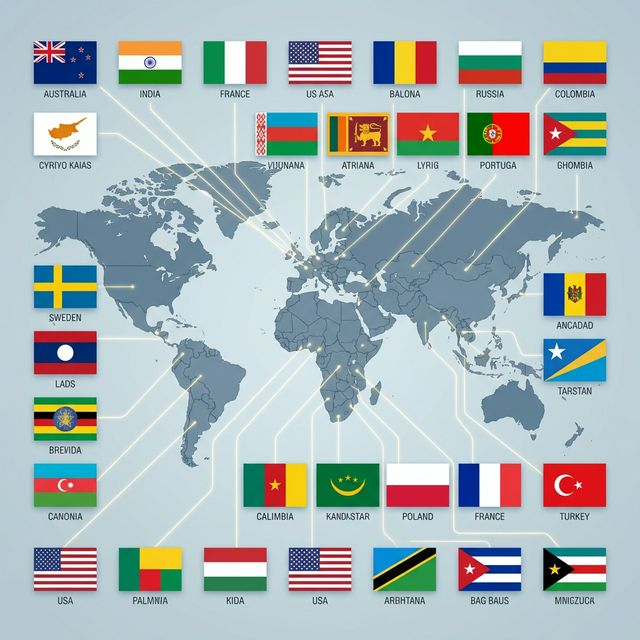
Flags are far more than arbitrary arrangements of color and shape; they are visual declarations of national identity, sovereignty, history, and cultural heritage. Every stripe, cross, emblem, and color shade on a flag tells a complex story about the country it represents, reflecting historical struggles, geological features, religious foundations, and political ideologies. In the realm of geography and educational games, understanding the deeper meanings behind national flags changes the experience from simple rote memorization to a fascinating journey through global history. Whether you are a student, a geography enthusiast, or a competitive player aiming for the top spots on the Flag Guess leaderboard at guess-games.com, developing a deep understanding of vexillology—the scholarly study of flags—will transform your gameplay, sharpen your visual recognition speed, and enrich your understanding of the world. In this comprehensive guide, we will unpack the rich symbolism, historical connections, design patterns, and memorization techniques that will help you master the flags of the world.
The Symbolism Behind Flag Colors
Colors are the most immediate and emotionally resonant elements of any flag, and their choices are rarely accidental. Across different cultures and history, specific colors have been adopted to symbolize shared experiences and ideals. Red is almost universally used to represent courage, revolution, and the blood shed by citizens in the struggle for independence and freedom. You see this in the flags of the United States, France, Turkey, and China. Blue is frequently selected to symbolize the sky, vast oceans, peace, and liberty, representing a nation's aspirations for tranquility or its connection to the seas, as seen in the flags of Greece, Somalia, and Argentina. Green holds deep significance in many nations; it often represents the fertility of the land, agriculture, hope, or holds religious meaning, particularly in Muslim-majority nations like Saudi Arabia, Pakistan, and Mauritania, where green is traditionally associated with Islam. White is most commonly associated with peace, purity, honesty, and unity, serving as a beacon of harmony in flags like those of Canada, Japan, and India. Yellow or gold is frequently chosen to represent the sun, mineral wealth, or the prosperity and bright future of the nation, as seen in the flags of Colombia and Ukraine (where yellow represents wheat fields under a blue sky). Black is a powerful color that can symbolize determination, heritage, or the overcoming of dark times, and it is a core component of many African national flags. To make sense of these colors in a geography trivia context, it is helpful to recognize established color families. The Pan-African colors—green, yellow, and red—were inspired by the flag of Ethiopia, the only African nation to resist European colonization during the Scramble for Africa. Flags like those of Ghana, Cameroon, Senegal, Mali, and Guinea all adopt these colors to show solidarity and independence. The Pan-Arab colors—black, white, green, and red—were historical colors used by various Islamic dynasties and were unified during the Arab Revolt of 1916. You will recognize them on the flags of Jordan, Kuwait, the United Arab Emirates, Palestine, and Egypt. The Pan-Slavic colors—red, blue, and white—originated from the Russian flag in the late 17th century and were later adopted by other Slavic nations to show cultural unity, appearing on the flags of Serbia, Slovakia, Slovenia, Croatia, and the Czech Republic. By categorizing a flag's color scheme into one of these families, you can instantly narrow its geographic origin to a specific region.
Common Flag Design Elements
Beyond color, the geometric layout and emblems on a flag provide crucial clues for identification. The most common layout is the horizontal tricolor, featuring three horizontal bands of color. This classic design became popular after the Dutch Revolt and the French Revolution, symbolizing liberty and equality. Another widespread layout is the vertical tricolor, used by nations like France, Italy, Ireland, and Mexico. These simple stripe patterns are often distinguished by the presence of a central coat of arms or national symbol. Crosses are another major design category. The Nordic Cross, which features an off-center vertical bar shifted toward the hoist side, is a defining motif of Northern Europe. Originating with Denmark's Dannebrog in the 13th century, this design was adopted by Sweden, Norway, Finland, and Iceland to reflect their shared historical and religious roots. Each country uses a distinct color combination: Denmark uses a simple white cross on red; Sweden features a yellow cross on blue; Norway adds a blue cross with a white outline to a red background; Finland displays a blue cross on white; and Iceland shows a red cross with a white outline on blue. Recognizing the Nordic Cross shape immediately tells you the flag belongs to a Scandinavian or Nordic country. Stars are highly popular emblems, representing unity, states, or guidance. The Southern Cross constellation is a unique visual marker found on flags in the Southern Hemisphere, representing their geographic location. You will find it on the flags of Australia, New Zealand, Brazil, Samoa, and Papua New Guinea. Another common emblem is the crescent moon, usually accompanied by one or more stars, which is a traditional symbol of Islam and appears on the flags of Turkey, Pakistan, Algeria, Tunisia, and Malaysia. The Union Jack canton (the upper-left corner of a flag) indicates historical ties to the British Empire and is featured on the flags of Australia, New Zealand, Fiji, and Tuvalu. Learning to identify these key structural shapes and symbols allows you to quickly group flags and make educated guesses.
Regional Patterns and Historical Connections
Flags do not exist in isolation; they are deeply tied to regional history and geopolitical alliances. Often, neighboring countries share design motifs due to common colonization, shared independence movements, or historical unions. A classic example is the flags of the former Federal Republic of Central America, which broke away from Spain in the 1820s. The original flag featured blue-white-blue horizontal stripes, symbolizing the land between the Pacific Ocean and the Caribbean Sea. Today, El Salvador, Honduras, Nicaragua, and Guatemala still use variations of this blue-and-white stripe pattern, often adding unique coats of arms or stars to distinguish themselves. Similarly, the countries of the former Republic of Gran Colombia—which was formed by Simón Bolívar in 1819—share a yellow, blue, and red horizontal tricolor. Colombia, Ecuador, and Venezuela all use this color combination. Colombia's flag features a yellow stripe that is double the width of the blue and red stripes. Ecuador's flag uses the same stripe proportions but adds the national coat of arms in the center to distinguish it. Venezuela's flag features equal-width stripes with an arc of eight white stars in the center. Recognizing this historical connection helps you avoid confusing these three South American nations. In Europe, the horizontal tricolor of white, blue, and red is a common pattern among Slavic nations, as mentioned earlier. However, the order of the stripes and the addition of coats of arms are key details. Russia uses white-blue-red stripes. Slovakia uses the same stripe order but adds its national shield on the hoist side. Slovenia also uses the white-blue-red order but places its mount Triglav coat of arms in the upper-left corner. Serbia reverses the order to red-blue-white and adds a royal coat of arms. Understanding these subtle variations within regional families is the key to achieving high scores in geography games.
Memorable Flag Stories and Facts
One of the best ways to memorize flags is to learn the unique stories and oddities that make them stand out. Some flags are famous for breaking all design rules. Nepal's flag is the only national flag in the world that is not rectangular. Instead, it consists of two stacked triangular pennants, representing the Himalayan Mountains and the two main religions of the country, Hinduism and Buddhism. Switzerland and Vatican City are the only two sovereign states in the world with square flags. Switzerland's flag features a bold white cross on a red square, which famously inspired the Red Cross emblem (which simply inverted the Swiss flag's colors to show neutrality). Other flags feature highly unusual or complex symbols. Mozambique's flag is the only national flag in the world to feature a modern assault rifle—an AK-47 crossed with a hoe over an open book, symbolizing defense, agriculture, and education. Bhutan's flag features the Druk, the Thunder Dragon of Bhutanese mythology, clutching jewels in its claws to represent wealth and security. The flag of Paraguay is unique because it has different designs on the front and back: the obverse features the national coat of arms, while the reverse features the Treasury seal and the motto 'Paz y Justicia' (Peace and Justice). Denmark's flag, the Dannebrog, holds the Guinness World Record for the oldest continuously used national flag, dating back to at least 1219. According to legend, the flag fell from the sky during the Battle of Lindanise to help the Danish forces win. Learning these fascinating anecdotes creates strong mental hooks that make flag recognition automatic and memorable. When you see a flag in a game, you won't just see colors; you'll recall the stories behind them.
Techniques for Flag Memorization
Mastering all 195+ sovereign national flags requires systematic study and practice. Spaced repetition is one of the most effective techniques: instead of trying to memorize every flag at once, study a set of 10-20 flags, review them the next day, and then again after three days. The Flag Guess game on guess-games.com is designed to support this approach, exposing you to a random selection of flags and helping reinforce your learning through gameplay. Visual association is another powerful tool. Connect the colors and shapes of a flag to a memorable image or fact about the country. For example, imagine Sweden's blue-and-yellow flag representing golden sunshine over blue Baltic waters. For Ireland, remember that green represents the Catholic population, orange represents the Protestant population, and white in the middle represents the hope for peace between them. This color coding makes the design logical and easier to recall. Active retrieval—testing yourself rather than passively looking at flashcards—is essential. Play regularly, track which flags you consistently confuse (such as Ireland and Ivory Coast, or Chad and Romania), and dedicate focused practice sessions to those pairs. By combining active gameplay with historical context, you will find that your recognition speed and accuracy improve dramatically over time.
Flags as Windows to the World
In conclusion, flags are not just colorful designs to be memorized for a high score; they are vibrant windows into the soul of a nation. Behind every color choice, stripe pattern, and coat of arms lies a history of revolution, independence, culture, and geography. By understanding flag symbolism and learning the stories behind them, playing geography games on guess-games.com becomes more than just pattern recognition—it becomes a journey of global exploration. This deeper knowledge not only improves your performance in games like Flag Guess but also broadens your cultural literacy and appreciation for our diverse world. Keep practicing, keep exploring, and enjoy the discovery of the rich stories that every flag has to tell.