 Love music trivia? 🎵 Try Weekly Spin, our daily social music discovery diary!
Bulls and Cows: The History Behind Guess the Number
The game "Guess the Number" might feel like a modern digital puzzle, but its roots go back far deeper than the first computer. It is based on a classic pencil-and-paper game known as "Bulls and Cows," a mental duel of deduction that has challenged logical minds for over a century. The endurance of this game is a testament to the timeless appeal of code-breaking and pattern discovery. Long before screens and microprocessors, players relied on simple grids, sharp pencils, and focused attention to solve these logical riddles. The transition of this game from physical notebooks to digital command lines, and eventually to modern web interfaces, illustrates the evolutionary path of logical puzzles. As we examine the history of Bulls and Cows, we see how a simple game of deduction became a cornerstone of early computer programming and a classic example of logic in action. This game is not just a diversion; it is an elegant introduction to systematic thinking, showcasing how structured rules can generate highly complex and intellectually stimulating challenges that continue to fascinate people of all ages across generations.
Origins in Pen and Paper
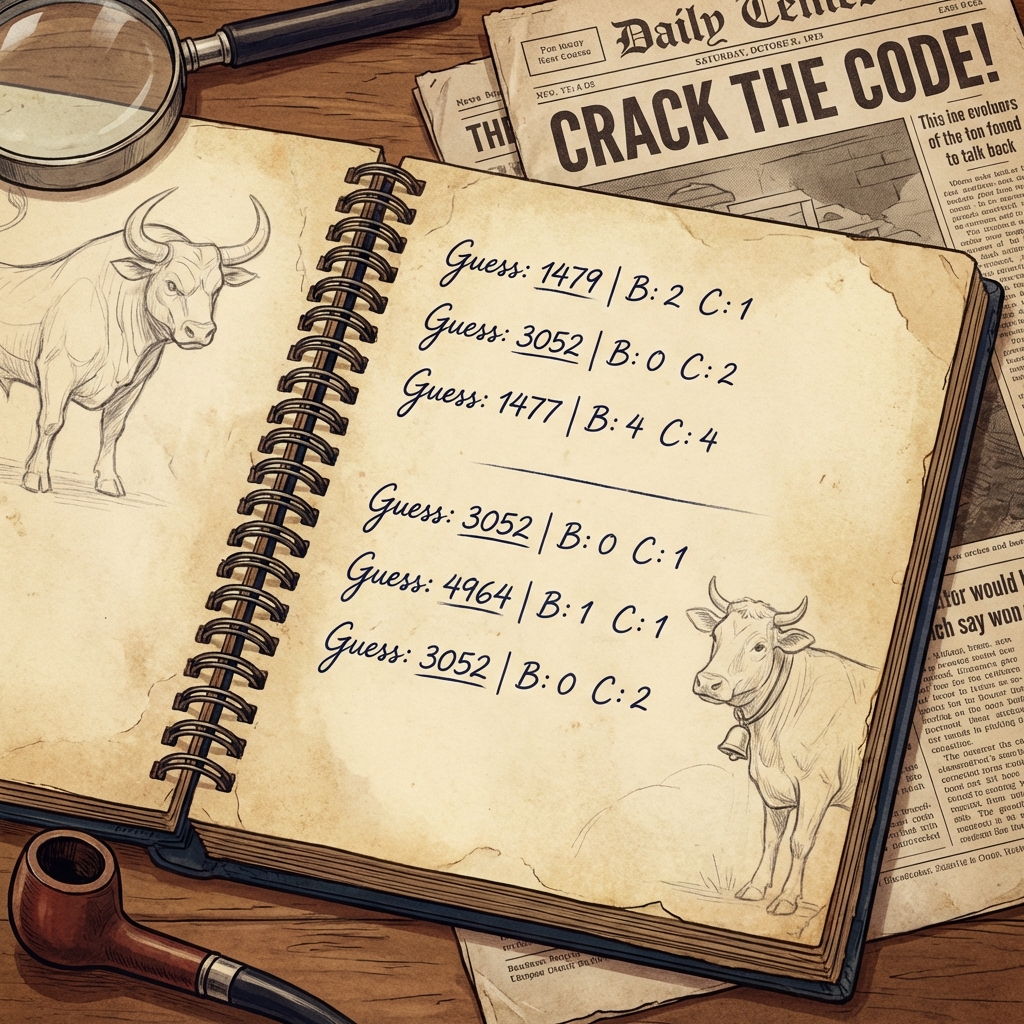
While the exact origin is unknown, Bulls and Cows is believed to have become popular in England in the late 19th or early 20th century. It was a game for two players. Each would write down a secret 4-digit number (with no repeating digits). The basic Bulls & Cows rules are simple but support a deep layer of mathematical strategy. One player, the "chooser," creates the secret number, while the other player, the "guesser," tries to figure it out by proposing different 4-digit combinations. For each guess, the chooser provides feedback in terms of "Bulls" and "Cows." A Bull represents a correct digit in the correct position, while a Cow represents a correct digit in the wrong position. Using this feedback, the guesser must systematically eliminate impossible combinations and narrow down the possibilities. This process requires a high level of concentration and structured reasoning, as a single error in deduction can lead the player down a false path, ruining their entire strategy. The game was highly popular in academic circles, serving as an intellectual pastime that could be played anywhere with just a scrap of paper and a writing tool, proving that complex logical challenges do not require elaborate equipment.
Players would take turns guessing. A "Bull" meant a correct digit in the correct position. A "Cow" meant a correct digit in the wrong position. The rigorous logic required to eliminate possibilities made it a favorite among mathematicians and computer scientists. The game is a prime example of logic and mathematical deduction in action, requiring players to perform complex conditional reasoning. For example, if a guess of "1234" yields one Bull and one Cow, the player must analyze which of the two digits are correct, and where they might belong. This systematic process of elimination is closely related to the scientific method, where each guess represents a hypothesis and the feedback represents experimental data. Mathematicians appreciated the game because it could be analyzed using combinatorics and information theory. The challenge was not just to guess the number, but to find the most efficient strategy to solve it in the minimum number of turns. This analytical focus made Bulls and Cows an excellent training tool for developing structured problem-solving skills, laying the foundation for its eventual adoption by early computer programmers who recognized its logical structure.
The Mastermind Connection
In 1970, Mordecai Meirowitz, an Israeli telecommunications expert, created a version with colored pegs instead of numbers. He called it "Mastermind." It became one of the best-selling board games of the 1970s. The evolution to Mordecai Meirowitz's Mastermind was a brilliant design innovation that made the abstract logic of Bulls and Cows visual and tactile. By replacing the 10 digits with six colors of plastic pegs and reducing the code length to four positions, Meirowitz made the game more accessible to a wider audience, including children, while retaining its deep logical core. The game's design was clean and intuitive: one player created a hidden code of four colored pegs, and the opponent had to guess the code, receiving black pegs for Bulls (correct color and position) and white pegs for Cows (correct color but wrong position). The game became an instant global phenomenon, winning numerous design awards and selling millions of copies worldwide. It proved that abstract mathematical logic, when packaged in an appealing visual format, could become a highly successful commercial product, securing its place in the history of modern board games.
The First Computer Game?
Because the rules are purely logical, Bulls and Cows was one of the very first games ever programmed for a computer. In the 1960s, it appeared on mainframes like the Titan computer at Cambridge University. It was called "Moo" and allowed users to play against the machine—often the only "fun" allowed on these expensive scientific tools. The mainframe Moo implementations were significant milestones in the history of early computer entertainment. In these text-based programs, the computer would generate a random 4-digit code, and the user would type in their guesses, receiving feedback in the terminal. Programming "Moo" was a popular exercise for computer science students and engineers because it required writing algorithms for generating unique random sequences, parsing user input, and calculating the Bulls and Cows count. It also provided a way for early programmers to demonstrate the interactive capabilities of computers, showing that they could be used for decision-making and logic, not just batch processing of numerical data. These early mainframe versions paved the way for the digital logic puzzles we play today, highlighting the close connection between coding and puzzle design.
Why Logic Games Endure
From Victorian drawing rooms to 1970s plastic boards to modern web apps, the core appeal remains the same: the satisfaction of pure deduction. Every guess is an experiment. Every result is data. Solving the puzzle is a triumph of the scientific method in miniature. The enduring appeal of code-breaking lies in this cognitive satisfaction. In a world full of ambiguity and complexity, logic games offer a clean, structured environment where every problem has a definitive, logical solution that can be reached through systematic effort. This appeals to our brain's natural desire to find order and patterns in chaos. From the perspective of information theory, playing Bulls and Cows is an exercise in entropy reduction. At the start of the game, there are 5,040 possible 4-digit codes (assuming no repeating digits), representing a high level of uncertainty or entropy. With each guess, the feedback we receive acts as information that reduces the set of possible codes, lowering the entropy. An optimal guess is one that maximizes the expected reduction in entropy, regardless of whether it contains a Bull or a Cow. This mathematical beauty, combined with the thrill of the chase, explains why code-breaking remains appealing to this day, serving as a timeless test of human intellect.