 Love music trivia? 🎵 Try Weekly Spin, our daily social music discovery diary!
Improving Your Glicko Rating
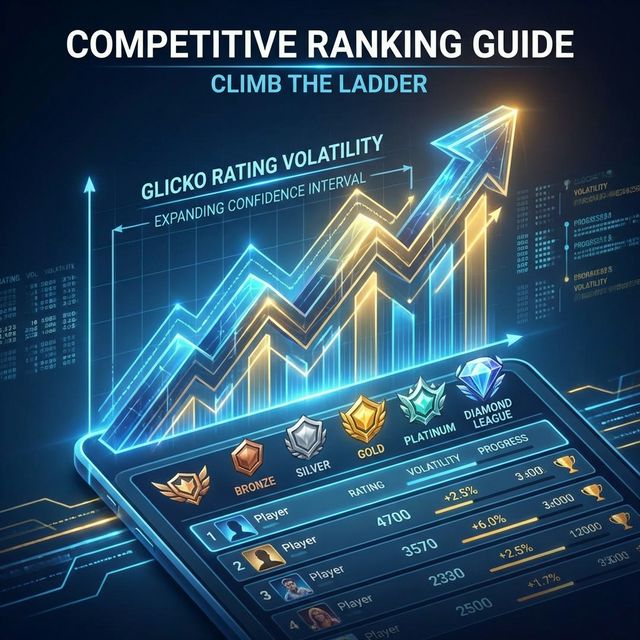
The Glicko rating system is a mathematically sophisticated method for tracking your skill levels and ranking you on our global leaderboards. Unlike simple point systems, Glicko measures both your rating and the system's certainty, creating a dynamic and fair competitive environment on guess-games.com. This guide explains how Glicko works and how you can strategically manage your rating.
Understanding Glicko System Mechanics
The Glicko rating system calculates two primary values for every player: your rating (representing your estimated skill level) and your Rating Deviation (RD), which measures the system's uncertainty about your rating. A high RD means the system is unsure of your true skill—usually because you are a new player or have not played recently. A low RD means the system is highly confident in your rating. When you play games, your RD decreases, indicating the system is gathering data and refining its estimate. When you are inactive, your RD slowly increases over time, reflecting growing uncertainty about whether your skill has changed. Understanding this dynamic is crucial for managing your rank.
Playing Against Varied Opponents
Your rating adjustments after a match depend heavily on your opponent's rating and their RD. Defeating a highly active player with a low RD (a well-established rating) will result in a larger rating increase than defeating a player with a high RD, whose rating is uncertain. Similarly, losing to a player with a much higher rating will have a minimal impact on your score, while losing to a lower-rated player will cause a larger drop. In Glicko, the system dynamically scales the rating stakes based on the reliability of both players' ratings, ensuring that your rating adjustments are fair and representative of your performance.
Managing Rating Deviation (RD)
Consistency is key to protecting and stabilizing your rating. Playing games regularly keeps your Rating Deviation low, which means your rating will remain stable and change in smaller, more predictable increments. If you take a long break from the platform, your rating will not decrease, but your RD will increase. When you return, your first few games will result in much larger rating swings (both up and down) as the system tries to re-establish your skill level. If you want to protect a high rating, keep your RD low by playing at least a few games every week.
Strategies to Improve Your Play
The most effective way to improve your Glicko rating is to focus on learning and skill acquisition rather than worrying about individual match outcomes. In music and geography games, study the detailed guides and historical patterns to build a solid knowledge base. In logic and number games, apply systematic elimination and deductive strategies. Practice in single-player modes to build your speed and accuracy before entering competitive multiplayer rooms. By focusing on constant learning and playing consistently to keep your RD low, your Glicko rating will naturally rise to reflect your growing expertise.
Climb the Leaderboards
In conclusion, your Glicko rating is a dynamic reflection of your growing skills on guess-games.com. By understanding the mechanics of rating deviation, choosing your matches wisely, playing consistently to maintain rating stability, and focusing on continuous skill improvement, you can climb the global leaderboards and measure your progress against the best players in the community. Keep challenging yourself, enjoy the competition, and watch your rank rise!