 Love music trivia? 🎵 Try Weekly Spin, our daily social music discovery diary!
The Educational Value of Trivia Games
Trivia games are often dismissed as mere entertainment, but decades of educational research tell a different story. Cognitive scientists have long recognized that retrieval practice—the act of pulling information from memory rather than passively reviewing it—is one of the most effective learning strategies available. Trivia games are, at their core, structured retrieval practice wrapped in an engaging, motivating format. From strengthening memory and building cross-disciplinary knowledge to fostering critical thinking and healthy social competition, these games deliver measurable educational benefits for learners of all ages. Whether you are a student preparing for exams, a teacher looking for engaging review tools, or simply someone who enjoys the thrill of testing your knowledge, understanding the science behind trivia can transform the way you think about play and learning. In this article, we explore seven key dimensions of the educational value that trivia games provide.
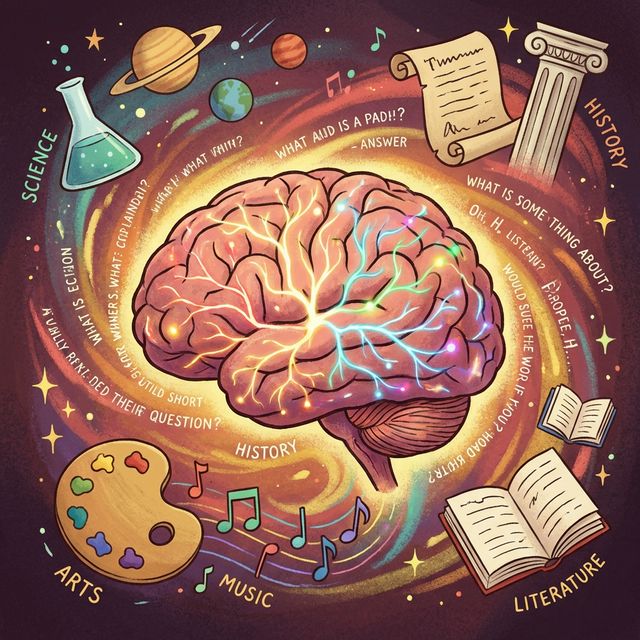
Active Learning Through Play
Trivia games transform passive learning into active engagement, a shift that educational research consistently identifies as one of the most important predictors of effective learning. Unlike reading a textbook or watching a lecture—activities where information flows in one direction—trivia games demand that players actively recall information, evaluate options, make decisions, and apply knowledge in real time. This process aligns with the higher levels of Bloom's Taxonomy, moving learners beyond simple recall into application, analysis, and even synthesis. When you play a music trivia game on guess-games.com, you are not just passively recognizing album covers. You are actively retrieving release years from memory, connecting albums to their cultural and historical eras, and synthesizing contextual clues—like cover art aesthetics or genre conventions—to make educated guesses. Album Year Guess requires synthesis of cultural and historical knowledge, pushing players to draw on multiple domains simultaneously. Gamification theory explains why this works so well: elements like points, streaks, and immediate feedback tap into intrinsic motivation. Players experience a sense of competence and autonomy—two pillars of Self-Determination Theory—which keeps them engaged far longer than traditional study sessions. The result is deeper processing, stronger neural pathways, and significantly better long-term retention compared to passive study methods.
Memory Enhancement and Cognitive Training
Regular play of trivia games provides rigorous exercise for memory and broader cognitive functions. The most powerful mechanism at work is the testing effect, a well-documented phenomenon in cognitive psychology showing that the act of retrieving information from memory strengthens that memory far more effectively than re-reading or re-studying the same material. Every time you answer a trivia question—whether correctly or not—you are engaging in retrieval practice that reinforces the underlying knowledge. Recalling facts under time pressure also strengthens working memory, the cognitive system responsible for holding and manipulating information in the short term. Recognizing visual patterns in flag designs, connecting musical eras to specific decades, or estimating numerical ranges all improve cognitive flexibility—the ability to switch between different mental frameworks. Research on the Ebbinghaus forgetting curve demonstrates that memories decay rapidly without reinforcement, but strategically timed retrieval—known as spaced repetition—can dramatically slow this decay. Trivia games naturally create spaced repetition opportunities: you encounter similar categories and topics across multiple play sessions, each time strengthening the memory trace. The challenge of remembering specific details—like whether a flag's stripe pattern is horizontal or vertical, or whether an album was released in 1997 or 2001—enhances both episodic and semantic memory systems. Studies suggest that engaging in mentally stimulating activities like trivia games can help maintain cognitive health as we age, making them a genuinely valuable investment of leisure time.
Knowledge Building and Retention
Trivia games expose players to a remarkably wide range of information across multiple subjects, building a broad knowledge base that grows with every session. Each game round introduces new facts, concepts, and connections that players might never encounter in their daily routines or formal education. The gamified format is crucial here: by making learning feel less like work and more like play, trivia games increase intrinsic motivation—the internal desire to continue learning for its own sake, rather than for external rewards. This stands in contrast to extrinsic motivation, which depends on grades, rewards, or pressure and tends to produce shallower engagement. When you get an answer wrong in a trivia game, something powerful happens: the emotional engagement of the moment—surprise, frustration, even laughter—combined with immediate corrective feedback creates what psychologists call a "desirable difficulty." This productive struggle makes the correct answer far more memorable than if you had simply read it in a textbook. Over time, this creates a virtuous cycle where curiosity drives exploration, exploration builds knowledge, and growing knowledge fuels further curiosity. In Flag Guess, players apply pattern recognition when grouping designs by region, gradually internalizing the visual language of vexillology—the study of flags—without ever opening a textbook. Regular players often report being surprised by how much incidental knowledge they have accumulated, from obscure capital cities to the release years of classic albums.
Critical Thinking and Problem-Solving
Beyond memorization and recall, trivia games develop higher-order critical thinking skills that are essential in academic, professional, and everyday contexts. Many trivia challenges require players to make logical deductions, recognize complex patterns, apply strategic reasoning, and evaluate competing hypotheses—skills that correspond to the analysis, evaluation, and synthesis levels of Bloom's Taxonomy. Guess the Number teaches systematic hypothesis testing: players must formulate guesses, interpret feedback (higher or lower), and iteratively narrow the solution space using binary search logic. This mirrors the scientific method in miniature—forming hypotheses, gathering evidence, and revising conclusions. Guess the Calculation develops mathematical fluency and the ability to work backwards from a target, requiring players to decompose problems, identify operations, and verify solutions mentally. In geography games, players need to make connections between regions, cultures, political histories, and historical events to identify flags or capital cities. This kind of integrative reasoning—pulling together disparate pieces of information to reach a conclusion—is precisely the skill that educators strive to develop. These games also build metacognitive awareness: players learn to assess their own confidence levels, recognize knowledge gaps, and allocate attention strategically. The time pressure present in many game modes adds an additional dimension, training players to think efficiently under constraints—a skill that transfers directly to high-stakes environments like exams, job interviews, and professional decision-making.
Social Learning and Healthy Competition
Learning does not happen in isolation, and trivia games tap into the powerful social dimensions of education. Multiplayer rooms on guess-games.com allow players to compete head-to-head in real time, creating a social learning environment where observation, comparison, and friendly rivalry all contribute to growth. Leaderboards provide visible benchmarks that contextualize individual performance within a broader community, while the Glicko rating system—a sophisticated algorithm also used in competitive chess—ensures that matchups and rankings reflect true skill levels rather than simply rewarding volume of play. This creates positive competitive pressure: seeing a rival's score climb motivates players to study harder, practice more frequently, and refine their strategies. Social comparison theory suggests that people evaluate their own abilities partly by comparing themselves to others, and leaderboards make this comparison transparent and motivating. Head-to-head matchups are particularly powerful because they provide immediate, concrete feedback on relative performance—you know exactly how you stack up against a real opponent. The social element also introduces collaborative learning opportunities. Players discuss strategies, share knowledge about tricky questions, and help each other improve. This peer-to-peer learning reinforces knowledge for both the teacher and the learner. The emotional engagement of competition—the excitement of a close match, the satisfaction of climbing the rankings—also enhances memory encoding, ensuring that facts learned during competitive play are remembered longer than those encountered in solitary study.
Cross-Disciplinary Knowledge Transfer
One of the most underappreciated benefits of trivia games is their ability to build connections across different fields of knowledge, fostering the kind of interdisciplinary thinking that modern education increasingly values. Unlike traditional coursework, which tends to compartmentalize subjects into separate silos, trivia games naturally blend multiple domains into a single experience. Music trivia, for example, is never just about music. Album Year Guess teaches cultural history—understanding why grunge dominated the early 1990s or why disco defined the late 1970s requires knowledge of social movements, technological changes, and cultural shifts. Players learn to connect artistic expression to its historical context, building a richer, more integrated understanding of both music and history. Flag games teach far more than geography. Identifying flags requires knowledge of political history (why do former Soviet republics share certain design elements?), cultural symbolism (what does the crescent moon represent?), and even colonial history (why do several African nations feature Pan-African colors?). In Flag Guess, players apply pattern recognition when grouping designs by region, unconsciously absorbing lessons in geopolitics and cultural identity. Capital city games reinforce both geography and political science, requiring players to understand the relationship between a nation's political structure and its administrative centers. This cross-pollination of knowledge creates a web of interconnected facts and concepts that is far more robust and useful than isolated pieces of information.
Practical Applications: Trivia in Education and Beyond
The educational potential of trivia games extends well beyond casual play, with practical applications in classrooms, workplaces, and homes. Teachers increasingly use trivia-style games as review tools before exams, leveraging the testing effect to help students consolidate knowledge in an engaging format. A geography teacher might use flag or capital city quizzes to reinforce unit content, while a music teacher could assign Album Year Guess as a creative way to explore music history. The immediate feedback loop in these games allows students to identify knowledge gaps in real time, making study sessions more targeted and efficient. In professional settings, trivia games serve as effective team-building exercises. Multiplayer rooms on guess-games.com allow colleagues to compete in a low-stakes, enjoyable environment that builds camaraderie while exercising cognitive skills. Companies have long recognized the value of gamified training, and trivia provides a lightweight, accessible format that requires no special setup or equipment. Family game nights benefit enormously from trivia games, which provide intergenerational learning opportunities where children and adults can learn from each other. Parents can model curiosity, good sportsmanship, and the growth mindset—the belief that abilities improve through effort—while children bring fresh perspectives and enthusiasm. Language learners find particular value in bilingual trivia platforms. The site supports both English and Spanish, allowing players to practice vocabulary, reading comprehension, and cultural knowledge simultaneously. Playing trivia in a second language creates meaningful, contextual exposure to new words and phrases—far more effective than rote vocabulary drills. Whether the goal is academic achievement, professional development, or simply family bonding, trivia games offer a versatile and evidence-based tool for lifelong learning.
Learning Made Fun
The evidence is clear: trivia games are far more than idle diversions. They are sophisticated learning tools that leverage some of the most powerful principles in cognitive science—retrieval practice, spaced repetition, the testing effect, and gamification—to deliver genuine educational value. From building broad, cross-disciplinary knowledge to developing critical thinking, metacognition, and social-emotional skills, the benefits of regular trivia play are both deep and wide-ranging. The beauty of trivia games lies in their accessibility: they require no textbooks, no classrooms, and no formal instruction. They meet learners where they are—on their phones, at their desks, or gathered around a table with friends and family—and transform idle moments into opportunities for growth. Whether you are a student seeking a more engaging way to review, a teacher looking for innovative classroom tools, or a lifelong learner who simply enjoys the thrill of discovery, trivia games on guess-games.com offer a rich, rewarding, and endlessly entertaining path to knowledge. So keep playing, keep questioning, and keep discovering—your brain will thank you.